

No.22
A curated mix of thoughts, discoveries and fresh perspectives to kickstart your day.
Ok ok bear with us on this one...
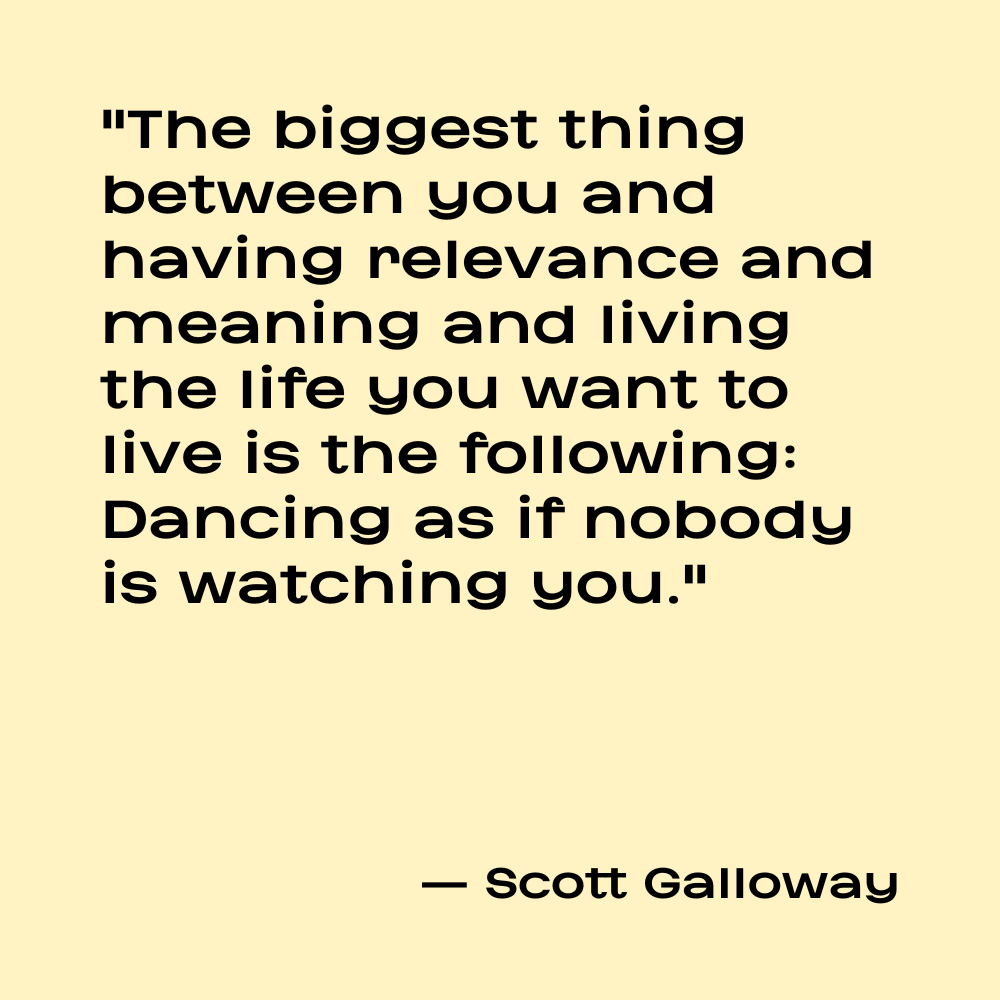
In a recent episode of The Prof G Pod, Scott Galloway opened by talking about Resist and Unsubscribe — a campaign he’d just launched calling for a coordinated economic strike against big tech. Whether or not it’s your thing, it is what he then went on to say that struck a chord.
He admitted that the only thing that had almost prevented him from doing it was the fear of public failure. The fear of throwing a party and nobody showing up.
Then he described watching someone get up and dance at a party. No rhythm. No audience. Just pure enjoyment. “That’s how you want to live your life,” he said.
We’ve all heard the line. It’s been on mugs, on posters and most likely popped up countless times in your social feeds. And for most of us, actual dancing-like-nobody’s-watching remains firmly in the category of things we admire from a safe distance.
But Galloway wasn’t really talking about dancing. He was talking about the fear of reaching out to someone you admire. The fear of going for the job you don’t feel qualified for. The fear of starting the thing. All the same instinct, dressed up differently.
“Your fear of public failure is a barrier, but it’s a two-inch high curb in your brain. It just doesn’t matter.”

We’ve been drawn to this kind of thing before. Obsolete Sony. The LAN party photobook. We make no apologies.
Nicole Nikolich’s user_history is a debut solo exhibition that pays tribute to early internet nostalgia — over 30 hand-crocheted, oversized flip phones, Nokias and Gameboys. Same attraction, new spin. The slowest, most deliberate medium imaginable, used to honour objects from our first era of digital distraction.
Digging a little deeper into Nicole’s work, we learned why she started crocheting. Following a mental health crisis, a doctor suggested it — the bilateral hand movements, the counting, the repetitive rhythm all work together to quieten the mind in ways that are well documented.
We’re not suggesting you pick up a crochet hook — although we’re also not stopping you either. Whatever gets you off a screen and demands your complete attention clearly has its merits.
user_history runs at Paradigm Gallery, Philadelphia from March 6th.
And Nicole, if you happen to read this — we’ll take a crocheted Sony Flamingo record player please.

A few weeks ago we shared Herbie Hancock saying thank you to his phone. Not because he thinks it’s human, but because extending grace to everything shapes who you are. We loved that. We wanted to be more Herbie.
Then we came across a Penn State study that tested whether being polite to AI actually improves its responses. Researchers rewrote the same questions five ways — from very polite to very rude — and tested them on ChatGPT. Very rude prompts scored 84.8% accuracy. Very polite ones scored 80.8%. Every comparison favoured directness.
So being Herbie is apparently making the AI worse.
The researchers’ explanation is worth sitting with though. Polite phrasing tends to wrap the actual question in linguistic clutter — “Would you be so kind as to...” adds words that carry no information. Direct language signals that the answer matters. It’s not the rudeness doing the work. It’s the clarity.
Which is actually very Herbie. He wasn’t gushing at his phone. He was extending quiet, considered grace. That’s not the same as being vague. Phew!
The best discoveries come from friends, not algorithms. Forward or share if you think of someone who might enjoy this.
GOOD DAYS is published by HORACE